
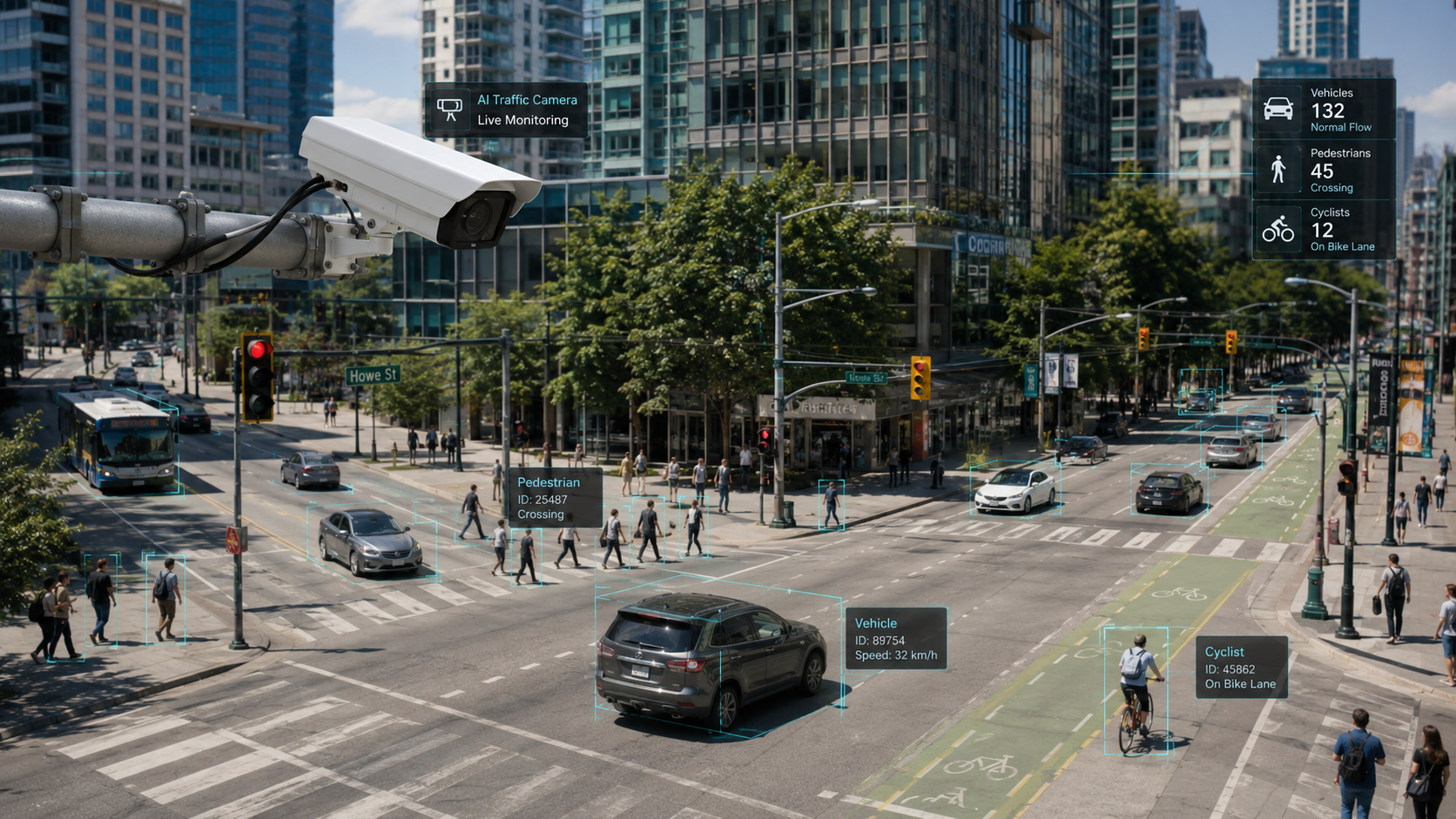
AI road safety cameras are becoming one of the most important traffic safety trends in 2026. Unlike traditional traffic cameras that mainly record speeding or red-light violations, these newer systems can study traffic movement, detect near-misses, and help identify dangerous intersections before serious crashes happen.
For drivers, pedestrians, cyclists, city planners, and accident investigators, this technology could change how road risks are understood. Instead of waiting for repeated collisions to prove that a road is unsafe, AI cameras can analyze patterns that show where crashes are likely to happen next.
What Are AI Road Safety Cameras?
AI road safety cameras are smart traffic monitoring systems that use artificial intelligence to review road activity in real time. These cameras can detect vehicles, pedestrians, bicycles, buses, motorcycles, traffic signals, turning movements, speed changes, and close calls between road users.
The biggest difference between a regular traffic camera and an AI-powered system is analysis. A standard camera records footage. An AI camera can identify patterns in that footage. For example, it may detect that drivers frequently turn across a crosswalk while pedestrians are still crossing, or that cyclists are repeatedly forced into vehicle lanes because of poor road design.
This makes the technology useful for accident prevention. The National Highway Traffic Safety Administration continues to emphasize road safety strategies that reduce serious injuries and fatalities. AI camera systems support that goal by helping communities understand risks before they become repeated crash statistics.
For readers interested in how camera footage can support accident claims, see our related guide on dash cam evidence and video admissibility.
Why Near-Miss Detection Matters
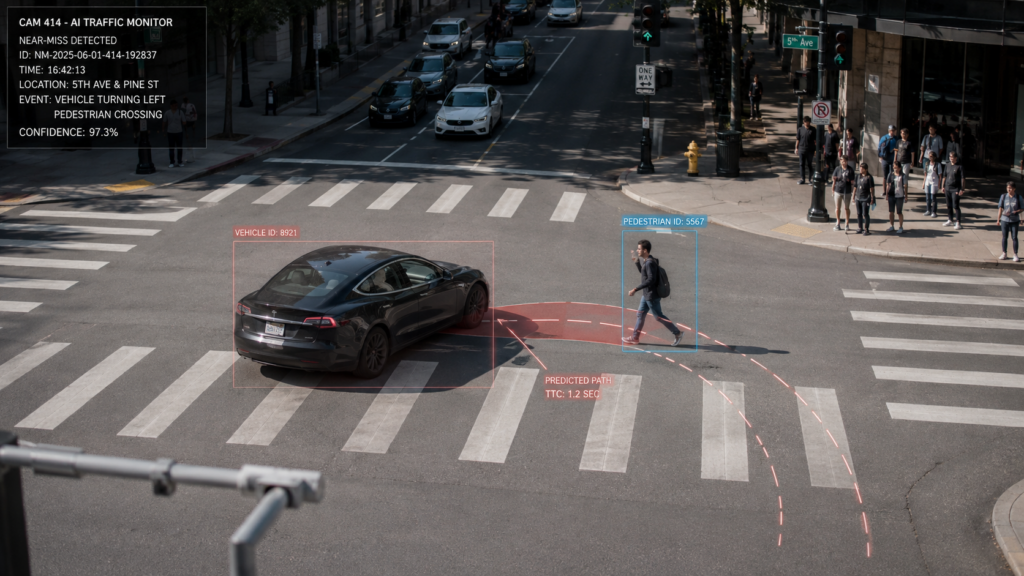
A near-miss happens when two or more road users almost collide but avoid impact at the last moment. These events are often not reported to police, insurance companies, or city agencies because no one is physically injured and no property damage occurs.
However, near-misses can reveal serious safety problems. If drivers repeatedly slam on their brakes at the same intersection, that location may have poor visibility, confusing signal timing, or unsafe turning patterns. If pedestrians often jump back from turning vehicles, the crosswalk may need better protection.
AI road safety cameras can detect these warning signs. By tracking movement paths, speed, distance, and timing, the system can identify dangerous interactions that human observers may miss. This gives traffic engineers stronger data when deciding whether to redesign intersections, add signals, adjust lane markings, or improve crosswalk visibility.
How AI Cameras Can Help Prevent Crashes
AI cameras help prevent crashes by showing where risks are building. Instead of relying only on past crash reports, cities can review real-time traffic behavior. This approach may be especially helpful in areas where crashes have not yet happened often enough to appear in official accident data.
For example, an AI camera may find that delivery trucks frequently block bike lanes during rush hour. It may show that drivers speed up to beat a yellow light near a school zone. It may reveal that pedestrians cross outside the marked crosswalk because the legal crossing point is too far away.
These details matter because crashes are not always random. Many collisions are connected to predictable road design issues, visibility problems, driver behavior, or traffic flow patterns. The Federal Highway Administration promotes safety-focused roadway planning through its zero deaths and safe system approach.
AI road safety cameras can support that type of planning by giving agencies a clearer view of how people actually use the road.
How This Technology Connects to Automatic Emergency Braking
AI road safety cameras are part of a larger shift toward smarter crash prevention. Vehicle technology is also moving in the same direction. Automatic emergency braking, pedestrian detection, lane assistance, and driver monitoring systems are becoming more common in newer vehicles.
NHTSA finalized a rule requiring automatic emergency braking and pedestrian automatic emergency braking on new light vehicles in the future. The agency explains that these systems are designed to help reduce rear-end and pedestrian crashes by detecting crash-imminent situations and applying the brakes when needed. You can read more from NHTSA’s automatic emergency braking rule.
Roadside AI cameras and in-vehicle safety systems are different tools, but they share the same goal. Both are designed to recognize danger earlier. The difference is that vehicle systems respond from inside the car, while traffic cameras help cities understand broader road patterns.
For another related technology topic, read our post on AI dashcams and smart accident detection.
Privacy Concerns Around AI Road Cameras
As helpful as AI road safety cameras may be, they also raise privacy concerns. These systems may capture vehicles, pedestrians, cyclists, license plates, faces, and daily travel patterns. Even when the goal is safety, communities may still worry about surveillance and data misuse.
Some cities and technology providers address this by blurring faces and license plates, limiting data storage, and using camera footage only for safety analysis instead of enforcement. These safeguards are important because public trust can affect whether communities support or reject AI traffic systems.
The Federal Trade Commission provides guidance on privacy and data security that can apply to connected technologies. Drivers and communities should ask how long footage is stored, who can access it, whether identifying details are removed, and whether the data is used for enforcement or planning.
Privacy is also a key concern in personal dash cam use. We discuss similar issues in our article on dash cam privacy laws in 2026.
Can AI Camera Data Help Accident Investigations?
AI road camera data may become useful in some accident investigations, especially when it shows how an intersection usually operates. Traditional crash evidence may include police reports, dash cam footage, surveillance video, witness statements, vehicle damage, and roadway photos.
AI traffic data could add another layer of context. It may show whether a certain intersection has repeated near-misses, frequent speeding, unsafe turning patterns, or visibility issues. This information may help explain why a crash happened and whether the location had known safety risks.
However, AI analysis is not perfect. Camera angle, lighting, weather, software accuracy, and data interpretation can all affect the value of the information. Any footage or AI-generated report should be reviewed carefully before being used as evidence.
This is similar to other technology-based evidence. Our guide on authenticating video evidence in court explains why digital footage must be verified before it can be trusted.
Benefits for Pedestrians and Cyclists
Pedestrians and cyclists are among the road users who may benefit most from AI near-miss detection. Many dangerous interactions involving walkers and cyclists never appear in crash reports because the person avoids impact at the last second.
AI cameras can help reveal these hidden risks. They may show that drivers fail to yield at crosswalks, that bike lanes disappear near intersections, or that turning vehicles come too close to cyclists. This information can support safer signal timing, protected bike lanes, pedestrian islands, curb extensions, and better lighting.
The Insurance Institute for Highway Safety tracks research on advanced driver assistance and crash prevention technologies. While vehicle-based systems are important, safer roads also require better infrastructure and planning.
Challenges With AI Road Safety Cameras
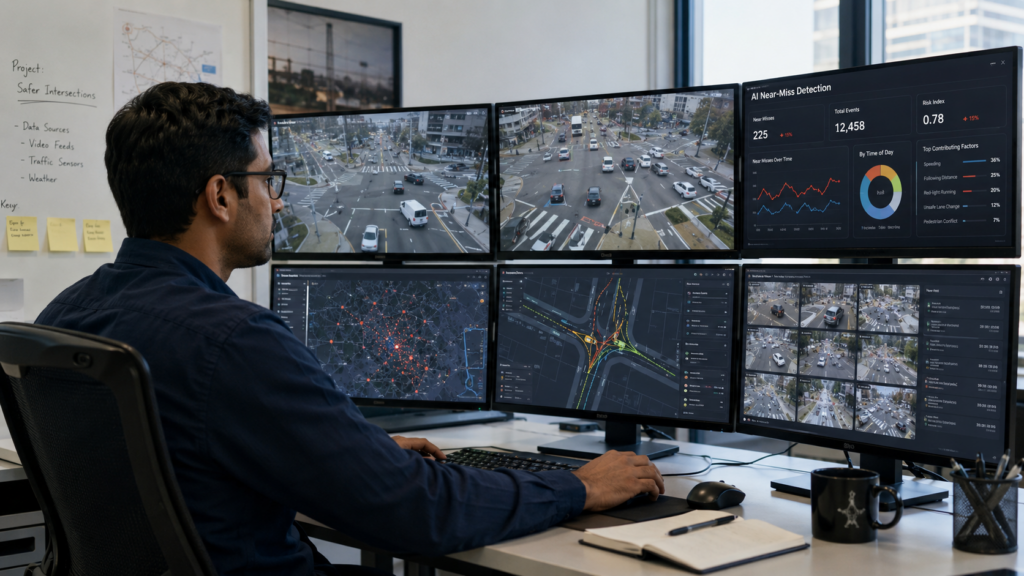
AI road safety cameras still have limitations. Poor weather, low light, glare, blocked camera views, construction zones, and unusual traffic behavior can affect performance. The system may also misclassify objects or misunderstand certain movements.
Another challenge is cost. Installing and maintaining AI camera systems can be expensive. Cities may need to decide whether these tools are worth the investment compared with other safety improvements like better lighting, road diets, protected bike lanes, and traffic calming measures.
There is also a transparency issue. Communities may want to know whether the cameras are being used only for safety studies or also for enforcement. Clear rules can help prevent confusion and build public trust.
The Future of AI in Accident Prevention
AI road safety cameras are likely to become more common as cities look for smarter ways to reduce crashes. In the future, these systems may connect with traffic signals, smart vehicles, public transit systems, and emergency response networks.
For example, an AI system could detect repeated near-misses at an intersection and recommend a signal timing change. It could identify a dangerous turning pattern and alert traffic engineers. It could also help prioritize which intersections need upgrades first.
The U.S. Department of Transportation National Roadway Safety Strategy focuses on reducing serious injuries and deaths through safer roads, safer vehicles, safer speeds, and post-crash care. AI camera technology may become one tool within that larger safety effort.
Conclusion
AI road safety cameras are changing how communities understand accident risks. By detecting near-misses, tracking traffic patterns, and identifying dangerous road conditions, these systems can help prevent crashes before they happen.
At the same time, privacy, accuracy, cost, and transparency must be handled carefully. AI should not replace human judgment, but it can give cities and safety experts better information.
As roads become smarter in 2026, the future of accident prevention may depend not only on what happens after a crash, but also on how well technology can spot danger before impact.