
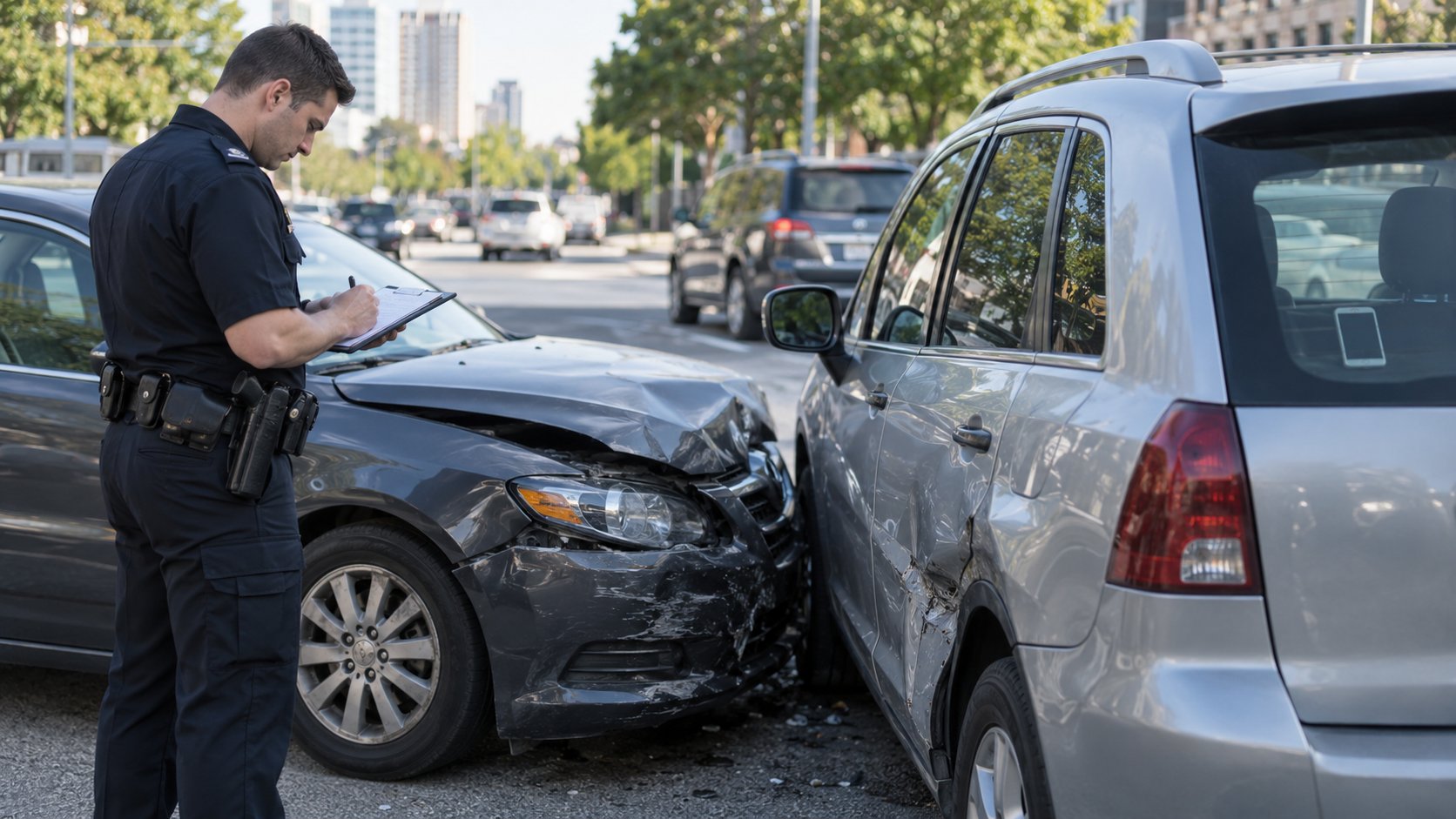
Cellphone distraction is widely recognized as a serious road-safety problem, yet official crash reports often fail to show how frequently phones are involved. A driver may have been texting, scrolling, watching a video, using navigation, or handling a phone seconds before impact, but the final police report may simply list speeding, failure to yield, unsafe lane movement, or another observable driving error.
New research is putting numbers behind this reporting gap. In August 2026, the Insurance Institute for Highway Safety reported that police crash reports may undercount cellphone use before crashes by a factor of at least seven. Researchers compared nearly 17,000 crashes with telematics data and found considerably more cellphone activity than police reports recorded.
That difference matters. Police reports influence traffic-safety statistics, enforcement priorities, public policy, insurance analysis, and how the public understands distracted driving. If cellphone distraction is routinely missed, the true scale of the problem may be hidden in plain sight.
Police Reports Capture What Investigators Can Prove
A crash report is not a complete recording of everything a driver did before a collision. Officers typically arrive after the impact, when vehicles have stopped, phones may have been put away, witnesses are gathering, and drivers are trying to explain what happened.
Unlike alcohol impairment, cellphone distraction has no simple roadside test comparable to a breath test. The National Safety Council notes that cellphone-related crashes are underreported in part because drivers may be reluctant to admit they were using a phone.
The National Highway Traffic Safety Administration similarly explains that pre-crash distractions often leave little physical evidence for investigators to observe. In many cases, identifying distraction depends on a driver’s statement, a witness account, video footage, or additional digital evidence.
That creates an immediate problem: the behavior most relevant to the crash may have ended before anyone else could see it.
A New Study Shows How Large the Gap May Be
The reporting problem became especially clear in a 2026 Insurance Institute for Highway Safety study on cellphone use before crashes. Researchers linked nearly 17,000 police-reported crashes in four states with anonymized telematics information collected through voluntarily enrolled safe-driving programs.
The telematics data detected cellphone use within 30 seconds before impact in about 7% of single-vehicle crashes and 8% of two-vehicle crashes. Police reports, by contrast, identified cellphone distraction in less than 1% of the crashes examined.
When researchers narrowed the window to the 10 seconds immediately before impact, cellphone activity was still detected in approximately 4% of single-vehicle crashes and 5% of two-vehicle crashes. The study concluded that police data may undercount pre-crash cellphone use by at least a factor of seven.
This does not mean every detected phone interaction caused the collision. A phone being active before a crash is not automatically proof of legal fault. But the gap demonstrates how much potentially relevant behavior can disappear from conventional crash reporting.

Why Drivers May Not Admit They Were Using a Phone
Self-reporting is one of the weakest links in distracted-driving data. After a collision, a driver may understand that admitting to texting or scrolling could affect a citation, an insurance claim, or a liability dispute. Even an otherwise cooperative driver may not remember exactly when they last touched the phone.
The National Safety Council’s distracted-driving data guidance warns that self-reported information is vulnerable to underreporting and false reporting. In fatal crashes, the problem can be even greater because the driver may be unable to provide any account at all.
Witnesses are not a perfect substitute. Someone in another vehicle may notice a phone held to a driver’s ear, but modern distraction can be much harder to see. A driver could tap a navigation app, read a notification, change a song, scroll social media, or watch content with the phone mounted below the window line.
That behavior may never be visible to anyone outside the vehicle.
The Report Form Itself Can Miss Cellphone Use
Another problem is the way crash information is recorded. Police crash-report forms are not identical across the United States. Some provide detailed distraction categories, while others use broader fields or depend heavily on the officer’s narrative.
The National Safety Council’s review of police crash reports found significant differences in how states capture risky driving behaviors and technology use.
NHTSA also notes that differences in reporting practices between jurisdictions can produce wide variation in distracted-driving statistics. A behavior that receives a specific code in one state might appear only in narrative text — or not at all — in another.
Technology changes faster than many reporting systems. Smartphones now combine calling, messaging, navigation, video, music, social media, voice assistants, and vehicle integration. A simple checkbox labeled “cellphone” may not accurately describe what the driver was doing or whether the device required visual, manual, or cognitive attention.
Other Violations May Overshadow Distraction
Cellphone distraction can also disappear when investigators have stronger evidence of another contributing factor. A crash may clearly involve excessive speed, a red-light violation, an unsafe turn, or following too closely. Those behaviors can be documented from vehicle positions, witness statements, video, skid evidence, or citations.
The distraction behind the error can be much harder to establish.
For example, an officer may confidently determine that a driver rear-ended stopped traffic but have no evidence showing why the driver failed to brake. The report may document unsafe speed or inattention without identifying the phone interaction that happened seconds earlier.
This distinction is important because crash reports often describe the observable driving failure rather than every behavior that may have produced it.
Phone Records Do Not Tell the Whole Story
It might seem that investigators could solve the problem simply by obtaining cellphone records. In practice, those records have limitations.
Traditional carrier records may document calls or conventional messages, but they may not reveal every interaction with an app or device. A driver could be reading previously downloaded content, using navigation, manipulating music controls, or interacting with an app in a way that is not obvious from a standard billing record.
Investigators also need an accurate crash time to compare digital activity with the collision. A difference of even a few minutes can affect whether a phone event appears relevant.
Obtaining detailed records can also require legal process and additional investigation. That level of evidence collection may be more common in serious or contested cases than in ordinary property-damage crashes.
Telematics May Reveal What Crash Reports Miss
Telematics is changing the conversation because it can capture behavior closer to the moment of impact. Safe-driving apps, fleet systems, and connected vehicles may collect data about movement, speed, braking, phone manipulation, and other events.
The 2026 IIHS study is significant because it compared this type of information directly with what responding officers recorded. The difference suggests that digital data can expose activity that traditional investigations frequently miss.
That fits a broader trend toward technology-based accident evidence. On Lights Camera Accident, we have examined how AI dashcams and smart accident detection can preserve details surrounding a collision.
Our guide to dash cam evidence in personal injury cases also explains why digital evidence must be properly preserved and authenticated.
Why Better Reporting Matters Beyond One Crash
Underreporting is not simply a paperwork problem. Traffic-safety programs depend on reliable data to decide where enforcement, education, technology, and funding should be directed.
In 2026, the Governors Highway Safety Association highlighted research into misreporting of distracted and impaired driving. The project identified underreporting, misclassification, and data-entry problems and offered strategies for improving the quality of crash information.
When cellphone distraction is systematically underestimated, policymakers may see a smaller problem than drivers are actually facing. That can influence decisions about enforcement campaigns, road-safety funding, driver education, crash-avoidance technology, and laws governing electronic-device use.
The issue is especially important because official numbers are already substantial. According to the Governors Highway Safety Association’s distracted-driving overview, thousands of people are killed each year in distraction-related crashes, while many more are injured.

Video Evidence Can Help Fill the Gap
Dashcams, traffic cameras, business surveillance footage, and other recordings can sometimes show what police cannot determine from driver statements alone. A video may reveal a driver’s head position, delayed braking, lane movement, or the moments immediately before impact.
Video still requires careful interpretation. A camera may show that someone looked downward, but it may not establish that the person was looking at a phone. Likewise, footage of poor driving does not automatically explain its cause.
Still, recordings can provide important context when combined with witness testimony, telematics, vehicle data, and other evidence.
Our article on AI road safety cameras and near-miss detection explores how newer systems can identify risky movements that may never appear in conventional crash statistics.
A Crash Report Is Important but Not Always Complete
Drivers, researchers, insurers, and safety officials should understand what a police crash report can and cannot establish. Reports remain valuable records of the scene, people involved, vehicle information, witness accounts, citations, and an officer’s observations. But the absence of a cellphone-distraction notation does not necessarily prove that no phone was being used.
The latest telematics research reinforces that point. A significant amount of phone activity occurring shortly before crashes may never make it into official police data.
For someone documenting a collision, preserving available evidence can therefore be important. Original dashcam files, photographs, witness contact information, and other digital records may provide details that are unavailable by the time a report is completed.
Drivers using recording devices should also be aware of the privacy issues discussed in our guide to dash cam privacy laws in 2026.
What Better Distracted-Driving Data Could Change
Improving crash data will require more than adding another checkbox to a police form. Investigators need consistent definitions, practical reporting procedures, training, and access to reliable evidence. States also need systems capable of keeping pace with new ways drivers interact with phones and connected vehicles.
Telematics may become one useful piece of that effort, particularly when data can be analyzed in aggregate without unnecessarily exposing personal information. Electronic crash reporting and better coordination between agencies may also reduce lost or misclassified information.
The goal is not to assume that every phone interaction caused a crash. It is to create a more accurate picture of when distraction was present so researchers and policymakers can distinguish evidence from guesswork.
The Bottom Line
Cellphone distraction is missing from many crash reports because it is unusually difficult to prove after the fact. Drivers may not admit using their phones, witnesses may never see the device, report forms may lack detailed categories, and phone activity may leave no obvious evidence at the crash scene.
New telematics research suggests the gap is much larger than official reports imply. When cellphone use detected shortly before crashes is compared with police records, the behavior appears far more frequently in the digital data.
That does not make every phone interaction the cause of a collision. It does show why distracted-driving statistics should be interpreted carefully. As dashcams, telematics, connected vehicles, and other digital evidence become more common, investigators may gain a clearer view of what drivers were actually doing in the crucial seconds before impact.