
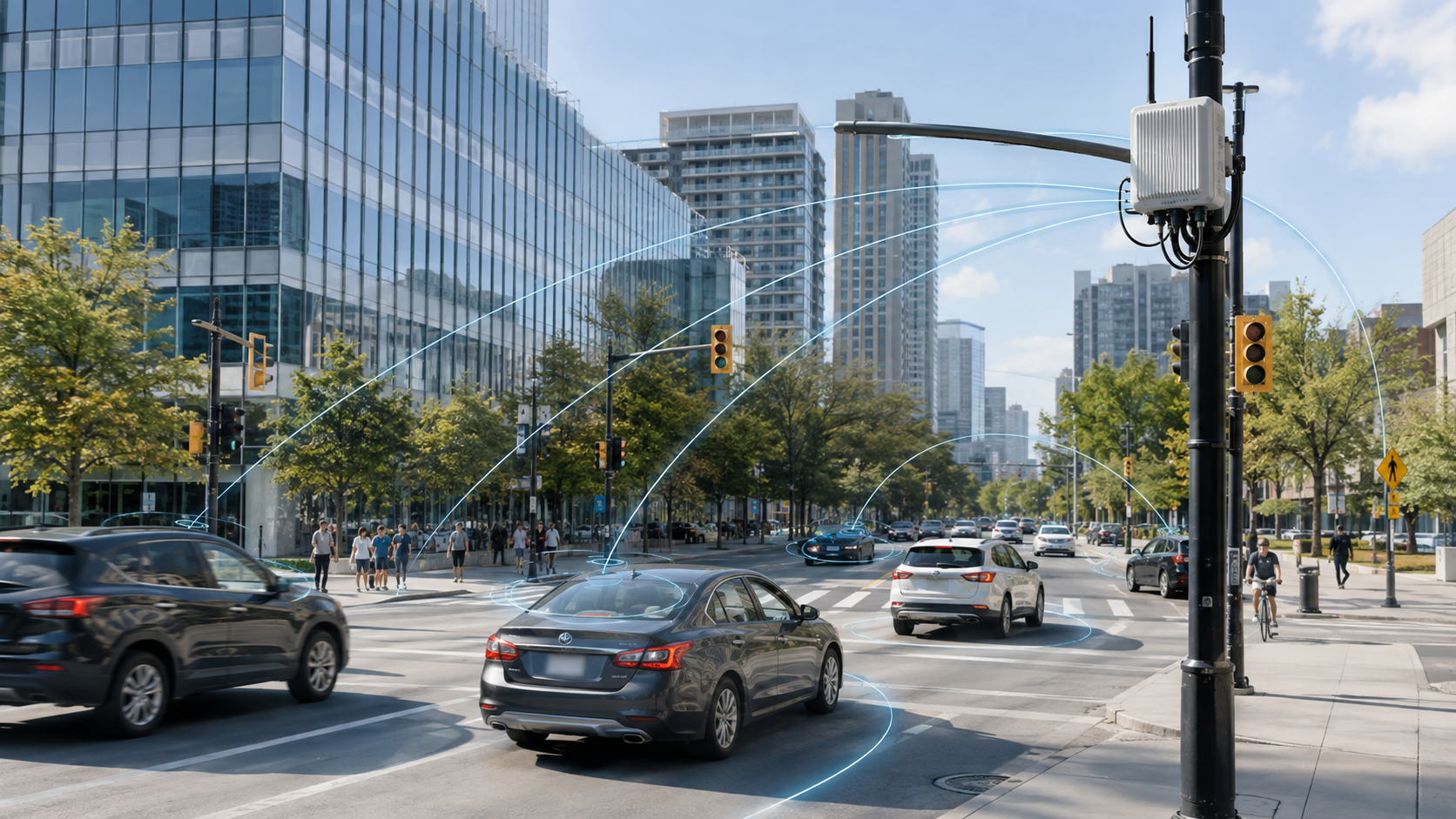
Cars are becoming more connected, but the next major road-safety change may happen outside the vehicle. Vehicle-to-Everything technology, commonly known as V2X, allows cars to exchange safety information with other vehicles, traffic signals, roadside equipment, and potentially pedestrians or cyclists using compatible devices.
In 2026, V2X is moving beyond small research projects and into broader real-world demonstrations. Transportation agencies are testing how connected vehicles can warn drivers about hazards they cannot yet see, including stopped traffic, red lights, emergency vehicles, work zones, and people entering crosswalks.
The technology could add an important layer of crash prevention because cameras and radar can only detect what their sensors can see. V2X can potentially provide information from around corners, beyond other vehicles, and farther down the road.
What Is V2X Technology?
V2X stands for Vehicle-to-Everything. Rather than describing one single safety feature, the term covers several types of wireless communication between vehicles and the transportation environment.
Vehicle-to-Vehicle, or V2V, allows nearby vehicles to exchange information such as position, direction, and movement. Vehicle-to-Infrastructure, known as V2I, connects cars with traffic lights and roadside equipment. Vehicle-to-Pedestrian, or V2P, is intended to help vehicles and vulnerable road users exchange safety information through compatible devices.
The U.S. Department of Transportation explains that V2X can improve situational awareness by allowing vehicles, infrastructure, and road users to communicate before a dangerous situation develops. Learn more through the USDOT Intelligent Transportation Systems Joint Program Office.
This approach complements technologies already inside modern vehicles. Cameras, radar, automatic emergency braking, and lane-assistance systems monitor the immediate environment, while V2X can potentially deliver information from beyond the vehicle’s direct line of sight.
That makes V2X a natural companion to the safety technology discussed in our article on AI road safety cameras and near-miss detection.
Why V2X Is a Major Road-Safety Trend in 2026
V2X has been discussed for years, but deployment activity has accelerated. USDOT’s national V2X strategy is focused on creating secure and interoperable communication between vehicles, roadside infrastructure, and other road users.
The agency’s V2X Accelerator Program includes major deployment projects in Arizona, Texas, and Utah. These projects are intended to demonstrate how connected transportation systems can operate at larger scale and across different locations. Details are available through the V2X Accelerator Program.
In 2026, USDOT also introduced an initial national V2X deployment map and showcased an open-source V2X mobile application. These developments indicate that connected-vehicle technology is moving from isolated testing toward more practical deployment.
Drivers are unlikely to notice a nationwide change overnight. V2X depends on compatible vehicles, roadside equipment, communication standards, and local infrastructure investments. However, each new deployment increases the number of real-world situations in which the technology can be evaluated.
How Cars Could Warn Each Other About Danger
One of the most promising uses of V2X is allowing vehicles to share warnings about hazards before another driver’s sensors can detect them.
Imagine a vehicle several cars ahead suddenly braking on a busy freeway. A traditional driver may not see the stopped traffic because SUVs or trucks block the view. A connected vehicle could potentially receive a warning about rapid braking before the danger becomes visible.
Other possible V2X applications include forward-collision warnings, blind-spot alerts, lane-change warnings, wrong-way vehicle alerts, curve-speed warnings, and notifications about stopped traffic.
USDOT lists numerous V2X applications that have been developed or demonstrated, including many safety-focused uses. More information is available through the USDOT V2X applications database.
These alerts would not eliminate the driver’s responsibility to pay attention. Instead, they could provide additional reaction time when a hazard is difficult or impossible to see.
Smart Traffic Lights Could Communicate With Vehicles
V2X is not limited to communication between cars. Traffic signals and roadside equipment can also participate in the network.
A connected traffic signal may be able to transmit information about its current phase and upcoming change. A compatible vehicle could use that information to warn a driver who is approaching a red light too quickly or help the driver prepare for a signal change.
At complex intersections, V2X could also support left-turn warnings and intersection movement assistance. These functions are especially relevant when another vehicle is hidden by traffic, buildings, landscaping, or other visual obstructions.
USDOT’s visualization on V2X benefits at signalized intersections highlights potential applications involving safety, traffic efficiency, public transportation, and emergency response.
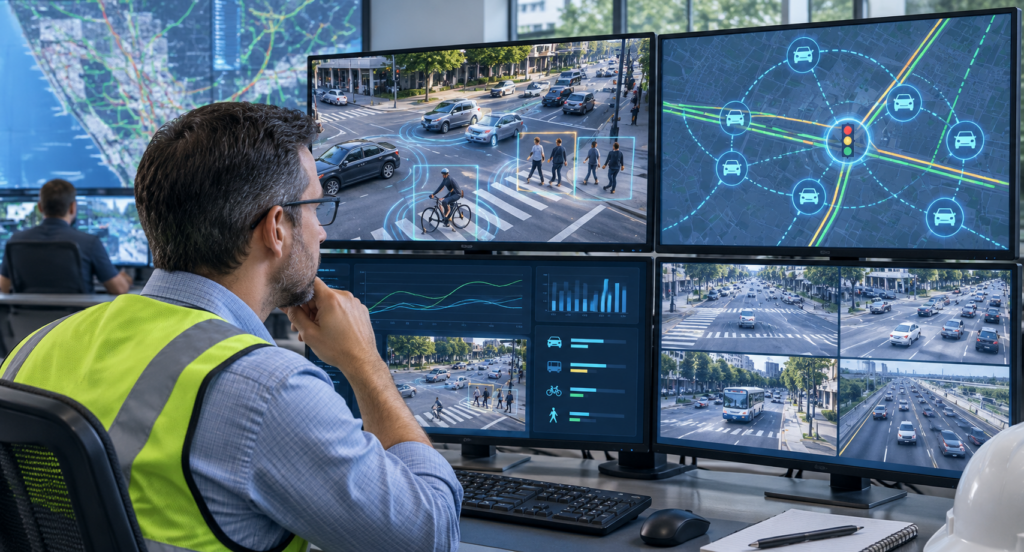
Connected infrastructure could also work alongside AI traffic monitoring. Our guide to AI near-miss detection explains how cameras can identify risky traffic patterns. V2X adds a different capability by transmitting warnings directly between road users and infrastructure.
Could V2X Better Protect Pedestrians and Cyclists?
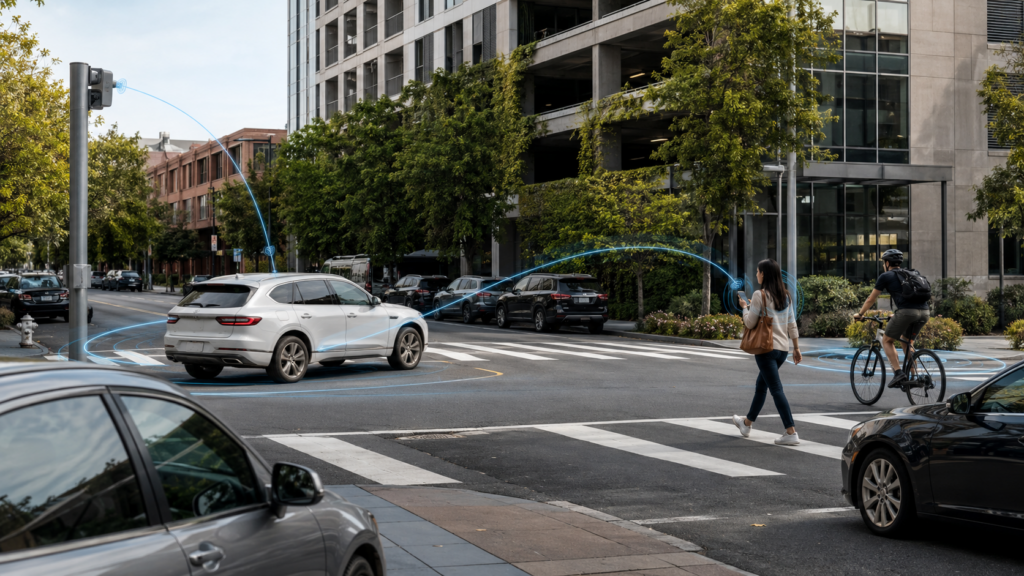
Pedestrian and cyclist safety is another important area for connected transportation. Cameras and automatic emergency braking systems can detect vulnerable road users, but visibility can still be limited by parked vehicles, buildings, darkness, or heavy traffic.
V2P communication is designed to extend awareness beyond what a vehicle’s own sensors can detect. For example, a compatible system could potentially alert a driver that a pedestrian or cyclist is approaching a crossing from behind an obstruction.
This type of technology is particularly interesting in urban environments where cars, bicycles, scooters, buses, and pedestrians frequently interact at close distances.
V2X does not guarantee that every person carrying a smartphone will automatically be detected. Systems need compatible equipment, communication standards, and appropriate privacy protections. Nevertheless, the possibility of alerting drivers to road users who are temporarily outside their field of vision could become an important safety benefit.
Emergency Vehicles and Work Zones Could Become Easier to Detect
Drivers sometimes hear an emergency siren before they can determine where the vehicle is coming from. Connected transportation systems could potentially provide more precise warnings about approaching ambulances, police vehicles, and fire trucks.
V2X infrastructure can also support emergency-vehicle preemption, which may allow traffic signals to coordinate with approaching emergency vehicles. This could help clear routes and reduce conflicts at intersections.
Work-zone alerts are another practical application. Construction areas can change quickly, and lane closures or workers may not always be visible until a driver is close to the site. V2X messages could provide earlier notification of reduced speeds, lane restrictions, road workers, or stopped traffic.
The USDOT V2X Deployment Evaluation program identifies work-zone safety, emergency response, traffic management, and vulnerable-road-user protection among connected-vehicle applications.
How V2X Differs From AI Dashcams
V2X and AI dashcams both use technology to improve road safety, but they perform different jobs.
An AI dashcam observes the road through its own camera and analyzes what is visible. It may detect sudden braking, lane departures, pedestrians, or collisions. V2X, in contrast, is based on communication between connected participants.
A dashcam may see the car directly in front of you. V2X could potentially warn your vehicle about another car braking several vehicles farther ahead. A camera may detect a pedestrian after that person becomes visible, while connected infrastructure could potentially provide an earlier alert.
For a closer look at camera-based technology, see our article on AI dashcams and smart accident detection.
V2X Still Faces Important Challenges
Despite its potential, V2X is not yet a universal safety network. One of the biggest challenges is interoperability. Vehicles and roadside equipment from different manufacturers must understand one another reliably if the system is going to work across cities and state lines.
Infrastructure cost is another issue. Transportation agencies may need roadside communication units, upgraded traffic controllers, network connections, cybersecurity systems, and ongoing maintenance.
Security and privacy are equally important. A connected road network must protect communication from manipulation while limiting unnecessary exposure of personally identifiable information.
The Federal Communications Commission has adopted rules supporting Cellular Vehicle-to-Everything, or C-V2X, operation in the upper portion of the 5.9 GHz transportation safety spectrum. The FCC’s V2X documentation discusses communications among vehicles, infrastructure, cyclists, pedestrians, and road workers.
Could V2X Data Matter After a Crash?
As connected vehicles become more common, V2X data could also become relevant after accidents. Depending on the system, available information might help establish whether a warning was transmitted, whether a traffic signal sent a message, or how vehicles were moving before a collision.
That does not mean V2X records will automatically determine fault. Like dashcam footage, event data recorders, vehicle telematics, or surveillance video, digital information must be preserved and interpreted correctly.
Questions may arise about who owns the data, how long it is stored, whether it is complete, and whether it accurately represents the events surrounding the crash.
Our article on dash cam evidence in personal injury cases explains similar issues involving authentication, preservation, and reliability of digital evidence.
How V2X Could Work With Automatic Emergency Braking
V2X may become especially useful when combined with automatic emergency braking and other advanced driver-assistance systems. Automatic emergency braking typically relies on cameras, radar, or other onboard sensors to recognize an immediate collision risk.
V2X could potentially provide additional information before that danger reaches the vehicle’s sensors. If another connected vehicle reports hard braking around a curve, for example, the receiving vehicle could warn its driver before stopped traffic becomes visible.
Similarly, roadside infrastructure could send information about traffic signals, work zones, emergency vehicles, or hazardous road conditions. When combined with onboard sensors, these messages could create a broader picture of what is happening around the vehicle.
The National Highway Traffic Safety Administration provides additional information about automated vehicle technologies and their role in transportation safety.
What Drivers Should Expect Next
V2X is likely to develop gradually rather than appear everywhere at once. Some regions will gain connected intersections and roadside equipment before others, while automakers will determine how quickly compatible communication technology enters production vehicles.
USDOT deployment projects are already creating larger environments where transportation agencies can evaluate connected-vehicle technology outside controlled testing facilities.
These projects can help researchers determine how connected systems perform in everyday traffic and whether they can deliver meaningful safety benefits at scale.
V2X will also exist alongside automatic emergency braking, driver-assistance systems, AI cameras, and increasingly automated vehicles. Rather than replacing these technologies, connectivity may allow them to work with information gathered from farther beyond the vehicle.
Conclusion
Vehicle-to-Everything technology could change accident prevention by allowing vehicles to receive warnings before hazards enter a driver’s direct view. Connected cars may communicate with one another, traffic signals may warn approaching vehicles, and vulnerable road users may eventually benefit from compatible V2P systems.
The technology still faces challenges involving infrastructure, compatibility, cybersecurity, privacy, and cost. Even so, the expansion of real-world V2X programs shows that connected transportation is becoming more than a future concept.
For drivers, the most important change may be simple: tomorrow’s safest car may not rely only on what its cameras and sensors can see. It may also rely on what the road, nearby vehicles, and infrastructure can tell it before danger appears.